Irreversible Change
I checked out the PACE Gallery in Chelsea yesterday. The signs outside were sufficiently vague that on arrival I first walked into a carpet shop next door thinking it was the gallery. The carpets were plush enough that only after a full inspection of the premises I was confident I had made a mistake. A simple, reversible mistake. I sheepishly walked next door to the actual PACE Gallery – on 510 West 25th Street.
The current exhibition is called The World of Irreversible Change. I’m drawn to this title. I often find myself distinguishing between Reversibles and Irreversibles when thinking through problems. Irreversible decisions deserve some space and reflection, while reversible ones should be made with glee. When working on a craft – paint/woodwork/composition/code – most acts are reversible. And yet, there’s more to a craft than an endless string of moves that can be Ctrl+Z’ed away. The boldest moves are irreversible ones. Like Cortés landing in Mexico, sometimes you have to burn the boats.
The main room has three digital animations.
The first animation shows flowers growing out of the ground, flourishing, and then dying. Every time a flower dies, its petals float up to heaven. The flowers appear and die chaotically, generatively. As you settle in to watch them it becomes clear there is a bigger cycle happening. The thicket of flowers grows more and more abundant through the cycle and the screens become more and more crowded, until they’re absolutely packed with flowers. Here is my artist’s rendition of what this looks like:
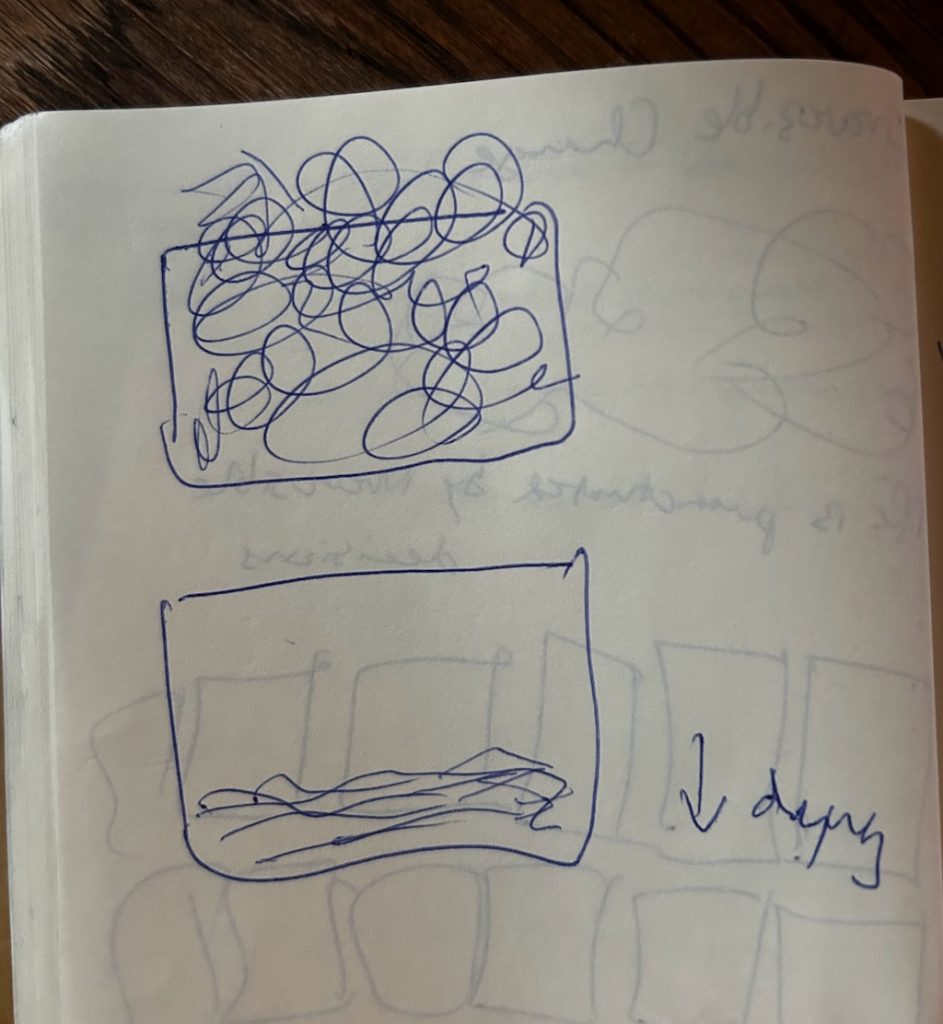
Then they all die in a beautiful crescendo.
After some time, a lone flower reappears and the cycle repeats.
The second animation is shown on a screen half the size of the first. It shows the ghosts of people, trees, and ornate buildings. They are silhouettes. Between them are thickets of flowers, the same flowers we were just admiring up close. Palls of yellow smog, perhaps a nuclear cloud, hang over the scene. The pace is slower. A blob of smog might drift past the full scene over the course of ten minutes. We have zoomed out in space and time, but even with our slower tempo we can’t see the cycle clearly. We know the hand on the clock is moving, but we don’t get the satisfaction of seeing it sweep full circle.
After this there is a blank wall. This feels like an absent animation. What happens here as you keep zooming out? I stare at it for a while, seeking cosmic secrets from a wall of white paint. I can see the glow of the other screens at the edges of my visions, distracting me. I can make out faint waves in the paintwork, splotches of eye glare. I then remember that I am staring at a blank wall and move on.
The third animation is the smallest. It’s only black and white, more abstract. It shows a surf of ink and hair and emptiness, crashing interminably into itself. It feels like a window into something that is usually hidden. A glimpse of what’s behind the plaster of the wall, peeled back. It surrounds the room. A contained box of motion. Never leaking a drop of energy to whatever lies outside, and thus never slowing down.
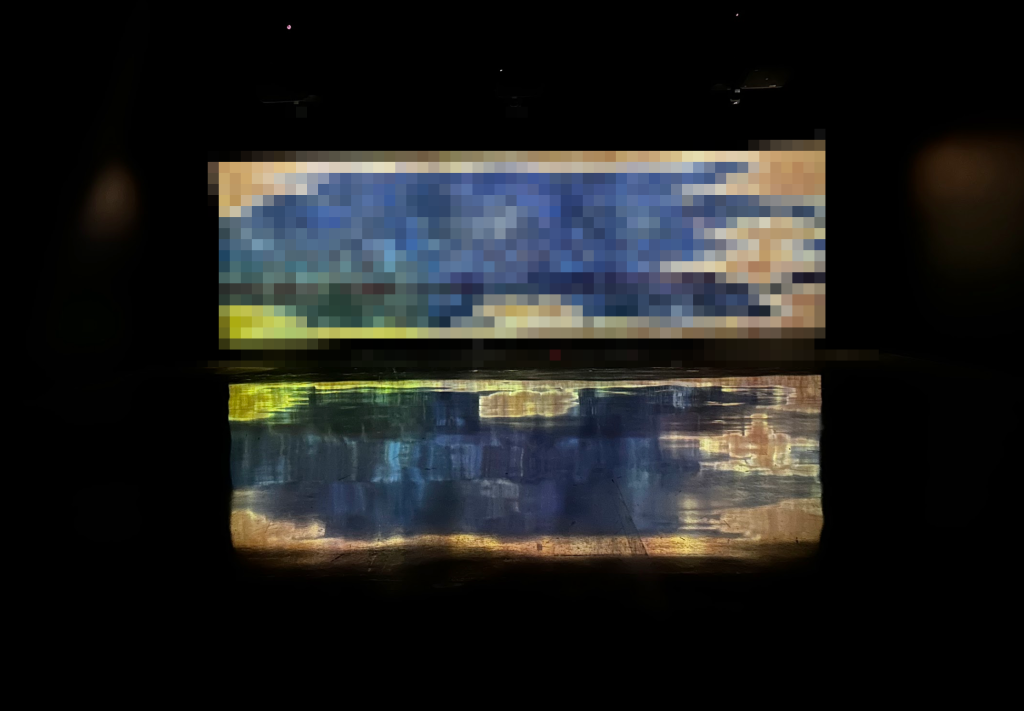
Beyond all this, it turns out there is actually more, because the exhibition has a hidden second room. It’s huge, twice the size of the first, and completely dark save for a vast screen with the final animation. This screen shows a completely wasted landscape. I’m there alone. My first instinct is to settle into a spot at the side of the room but LOOK AT ALL THIS SPACE! I sit in the centre of the room and drink it in. I enjoy liberty in the darkness.
The animation shows a scene of death. What had been bushes of flowers, ornate little bridges, human bodies working – all are now just ghostly silhouettes in a scene of destruction.
I took an illegal photo. Here it is, with the animation blurred out:
TeamLab describe themselves as an ultratechnologist collective. Their work is clever and thoughtful. The flowers and weather reflect real-world seasons and locale. The scenes start fresh every morning and decay through the day. Their exhibitions are bright, interactive, and often quite commercial. They write about the search for “peace without order.” Given the rising of accelerationist thinking – ideologies that call for the drastic intensification of capitalist growth and technological change – settling for change without annihilation feels like a savvy compromise.
I left the exhibition and after some local exploration, discovered that the main part of the PACE gallery is up the street, 540 West 25th Street, and I had been enjoying the relative quiet of a smaller outpost at number 510. In the main gallery I enjoyed the soft paintwork of Vietnamese artist Huong Dodinh and some quirky CD-ROM sculptures by Tara Donovan. The doomful mega-cycle foreboding of the TeamLab work filled me with solemn nodding energy, which I enjoyed, but I was glad to have something softer to wrap myself in afterwards.